
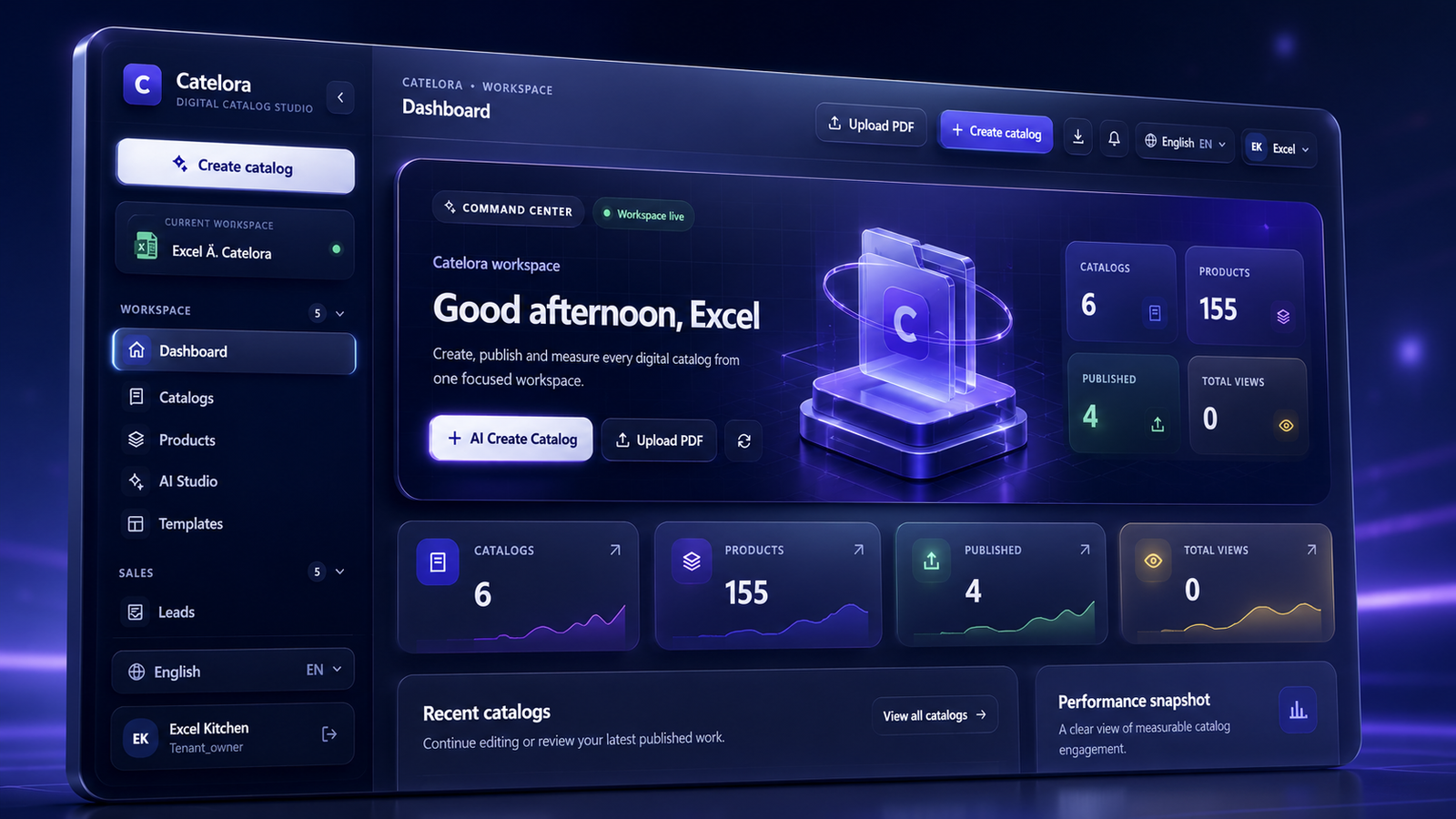
Most digital catalogs still behave like static documents. They may display products clearly, but they rarely help businesses understand customer interest, capture qualified leads or move potential buyers into a structured sales process.
Catelora was created to change that. Developed by Destpeka Digital, Catelora is a multi-tenant SaaS platform that transforms catalogs and PDF documents into interactive, measurable and commercially useful digital experiences.
A catalog should not only present products. It should help businesses understand interest, start conversations and generate sales opportunities.
What Is Catelora?
Catelora enables businesses to create interactive digital catalogs and flipbooks, distribute them across multiple channels and track how visitors engage with every publication.
Instead of using separate tools for catalog creation, analytics, lead management, quotations and sales tracking, businesses can manage the entire process from a connected workspace.
The platform is designed for manufacturers, wholesalers, retailers, distributors, hospitality suppliers, agencies and other businesses that depend on visual product presentations.
From Catalog Creation to Sales Conversion
Catelora connects content creation with customer acquisition and sales operations. A typical workflow includes:
- Creating a branded business workspace.
- Uploading an existing PDF or building a catalog with the visual editor.
- Publishing the content as a responsive digital flipbook.
- Sharing it through a public link, QR code, embedded viewer or custom domain.
- Allowing visitors to explore products and interact with hotspots.
- Capturing product inquiries, contact requests and quotation requests.
- Converting qualified leads into quotations.
- Managing opportunities through a structured sales pipeline.
- Connecting confirmed sales with inventory and delivery operations.
This workflow turns the catalog from a passive marketing asset into an active part of the business development process.
A Flexible Catalog Creation Experience
Block-Based Visual Editor
Catelora includes a modular editor that allows teams to build catalog pages using reusable content blocks. Businesses can create product layouts, hero sections, image galleries, comparison sections, contact areas, data blocks and branded footers without rebuilding every page from the beginning.
Products and images can be connected directly to page elements. Reusable blocks can also be saved to maintain visual consistency across different catalogs and campaigns.
PDF-to-Flipbook Publishing
Businesses that already have PDF catalogs can upload them and convert them into responsive flipbook experiences. The viewer supports page-turning interactions, mobile swipe gestures, zoom, fullscreen mode, thumbnails and page navigation.
Interactive hotspots, product links and call-to-action buttons can then be placed over the existing PDF pages, giving traditional documents a new digital layer.
Interactive Product Discovery
Visitors can do more than move between pages. They can open product details, select interactive areas, follow links and submit inquiries without leaving the catalog experience.
These interactions give businesses a clearer understanding of which products, pages and offers attract the most attention.
- Interactive product hotspots
- Product detail pop-ups
- Call-to-action buttons
- Contact and inquiry forms
- Quotation request forms
- Mobile-friendly catalog navigation
Analytics That Explain Customer Interest
Catelora provides catalog-level and page-level analytics to help businesses understand visitor behaviour. Teams can evaluate how customers discover a catalog, which pages they visit and which products generate meaningful interaction.
Analytics can include:
- Unique visitors and total page views
- Catalog sessions and session duration
- Popular pages and products
- Product clicks and hotspot interactions
- Traffic sources and referral information
- Device and browser information
- Engagement and bounce indicators
This information helps marketing and sales teams improve catalog structure, product placement and campaign performance using real interaction data.
Built-In Lead Capture and CRM
When a visitor submits a contact form, product inquiry or quotation request, Catelora records the request together with its original context.
The business can identify which catalog generated the lead, which product attracted the visitor and which channel brought the customer to the publication.
Leads are organised inside a tenant-specific CRM inbox where teams can review customer information, update lead status, add notes, filter records and assign opportunities to responsible team members.
From Lead to Quotation
Qualified leads can be converted into quotations without manually recreating all customer and product information. Relevant catalog, product and contact details can be carried forward into the quotation workflow.
Sales opportunities can then move through a structured pipeline:
- New
- Contacted
- Qualified
- Quotation
- Negotiation
- Won
- Lost
Status changes and revisions can be recorded, giving management a clearer view of conversion progress and sales performance.
Multi-Tenant Architecture for Growing Businesses
Catelora is designed as a multi-tenant platform. Every organisation works inside its own isolated workspace with separate catalogs, products, media files, users, analytics, leads and business settings.
This architecture enables multiple companies to use the same platform securely while maintaining independent data, branding and operational controls.
Roles and Permissions
Workspace access can be managed through role-based permissions such as Owner, Admin, Editor and Viewer. This allows businesses to control who can manage settings, edit catalogs, review analytics or access customer data.
White-Label Publishing
Businesses can publish catalogs using their own logo, brand colours and custom domain. This creates a consistent customer experience without exposing the underlying platform identity.
Developer APIs and Webhooks
Catelora is also designed to connect with external systems. Tenant-specific API keys can provide controlled access to catalogs, products, analytics and lead information.
Signed webhooks can notify connected applications when important actions occur, such as a new lead, quotation request or catalog interaction.
- Tenant-specific API keys
- REST API endpoints
- OpenAPI-compatible documentation
- HMAC-signed webhook payloads
- Delivery history and retry mechanisms
- Integration-ready modular architecture
Technical Foundation
Catelora is being built with a modern technology stack focused on performance, maintainability and future scalability.
- Next.js 14
- React
- TypeScript
- PostgreSQL
- Drizzle ORM
- Supabase
- Tailwind CSS
- Next-Intl
- REST API architecture
- Tenant-aware database design
The platform roadmap also includes scalable background processing, cloud storage, CDN distribution, advanced monitoring, AI-assisted catalog creation and a template marketplace.
More Than a Digital Flipbook
Catelora is not designed to be only a PDF viewer or catalog design tool. Its purpose is to connect product presentation, visitor analytics, lead capture, quotations, sales management and operational workflows within one platform.
It represents Destpeka Digital’s approach to digital transformation: replacing disconnected tools with integrated systems that create measurable business value.
With Catelora, every catalog can become an interactive sales channel.